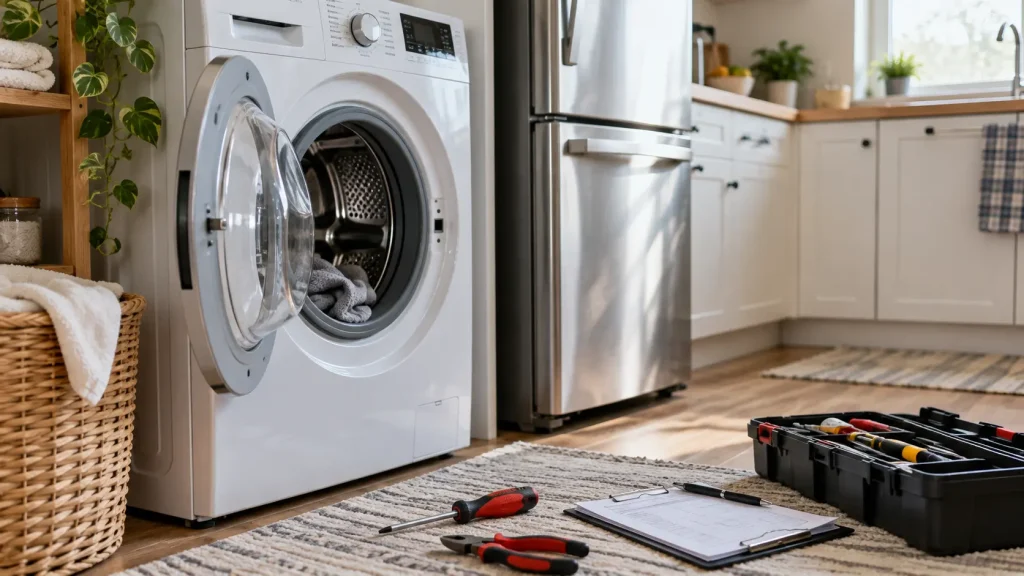
A washing machine stops spinning. The refrigerator suddenly starts making an unfamiliar noise. Your dishwasher still works, but only after running the cycle twice.
The first question is usually the same:
Is it worth repairing, or should I replace it?
There isn’t one rule that works for every appliance. A $250 repair might make perfect sense on a relatively new refrigerator but be difficult to justify on an older machine that has already needed several repairs.
A better decision comes from looking at five things together: the repair cost, replacement cost, appliance age, recent reliability and operating cost.
Here’s a practical way to work through it.
Start With the Actual Repair Cost
Before shopping for a replacement, find out what’s wrong.
A service technician may charge a diagnostic fee before providing a repair estimate. Ask whether that fee will be applied toward the repair if you decide to proceed.
For an expensive repair, a written estimate is useful because it should make clear what you’re actually paying for:
- replacement parts
- labor
- diagnostic charges
- service or call-out fees
- taxes
- any warranty on the completed repair
If the diagnosis is uncertain or the repair is particularly expensive, getting a second opinion can be worthwhile.
Now compare the total repair cost with what you would realistically spend replacing the appliance.
Not the price of the most expensive new model.
Not the cheapest advertisement you can find.
Use the price of a replacement you would genuinely be willing to buy.
For example:
Repair estimate: $220
Comparable replacement: $850
$220 ÷ $850 = about 26%
That number gives you useful context, but it shouldn’t make the decision by itself.
Don’t Treat the 50% Rule as a Law
You’ve probably seen advice saying:
Replace an appliance if the repair costs more than 50% of a new one.
It’s a useful warning sign, but real decisions are more complicated.
Imagine two refrigerators that both need a $400 repair.
One is four years old and originally cost $1,500.
The other is 14 years old and has already been repaired twice.
The repair bill is identical, but the sensible decision may be completely different.
Age and condition matter because what you’re really buying with a repair is additional useful life.
Instead of asking only:
“Is $400 cheaper than buying a new refrigerator?”
Ask:
“How many more reliable years am I likely to get for this $400?”
That is usually the more useful question.
Appliance Age Changes the Calculation
Every appliance eventually reaches a point where repairs become harder to justify.
That doesn’t mean you should throw something away just because it has reached a particular birthday.
A well-maintained older appliance may continue working reliably. A newer one may develop an expensive failure unusually early.
Age is better used as context.
If an appliance is relatively young and this is its first significant problem, repairing it often deserves serious consideration.
If it is already well into the later part of its expected service life, replacement becomes more attractive — particularly when the repair is expensive.
Consumer Reports cites broad estimates showing just how much useful life can vary by appliance. Refrigerators, for example, may commonly fall around the 9–13 year range, while dryers are around 13 years and ranges can last longer. Individual machines can fall well outside those ranges.
So don’t interpret an average lifespan as an expiration date.
Use it to understand where your appliance is in its life cycle.
Look at the Appliance’s Repair History
This is one of the easiest factors to overlook.
Suppose you’ve already spent:
- $140 last year
- $190 six months ago
- and now face another $300 repair
Looking only at today’s $300 estimate hides part of the story.
Repeated failures can indicate that you’re entering a cycle where one aging component is followed by another.
On the other hand, a machine that has worked reliably for eight years and suddenly needs one straightforward repair may still be worth fixing.
Pull out previous receipts if you have them.
Ask:
How much have I spent on this appliance during the past two or three years?
That answer can change the decision.
Check the Warranty Before Paying Anyone
Before authorizing a repair, check whether the appliance or failed component is still covered.
Some products have different warranty periods for different parts. The overall appliance warranty might have expired while a particular component still has longer coverage.
Also check any service contract or extended coverage you purchased.
Don’t assume that an “extended warranty” automatically means the repair will be free. Service contracts can contain deductibles, service fees, exclusions and restrictions on who can perform the work.
Read the actual coverage.
If the appliance is still under warranty, contact the manufacturer or seller before paying for an outside repair.
Energy Costs Matter — But Don’t Overestimate Them
An older appliance can cost more to operate than a newer efficient model, but the potential savings vary enormously by appliance and by how old your existing machine is.
Refrigerators are a good example because they run continuously.
ENERGY STAR says refrigerators more than 15 years old can cost significantly more to operate, and modern certified refrigerators are more efficient than models meeting only the federal minimum standard.
That makes energy consumption worth considering when an old refrigerator also needs an expensive repair.
But don’t replace a perfectly functional three-year-old appliance simply because a newer model advertises better efficiency.
Calculate the likely savings first.
If a new appliance saves $40 per year but costs $1,000 to replace, energy savings alone won’t quickly recover the purchase price.
Efficiency is most useful as an additional reason to replace an old, unreliable appliance — not automatically as the only reason.
When Repair Usually Makes More Sense
Repair deserves a closer look when:
- the appliance is still relatively young
- this is its first major failure
- the repair cost is modest compared with replacement
- replacement parts are readily available
- the machine otherwise performs well
- the repair comes with a reasonable parts-and-labor warranty
- replacing the appliance would involve additional installation costs
That last point matters.
Replacing a built-in dishwasher, wall oven or HVAC system may involve much more than the sticker price of the new equipment.
Delivery, installation, removal, electrical work, plumbing or modifications to cabinetry can all change the real replacement cost.
When Replacement Starts to Make More Sense
Replacement becomes easier to justify when several warning signs appear together:
- the appliance is approaching the later part of its expected life
- the repair is expensive
- it has broken down repeatedly
- replacement parts are difficult to obtain
- performance has noticeably deteriorated
- operating costs are increasing
- the appliance no longer meets your household’s needs
- a major component has failed and other components are also aging
Notice that this isn’t one single trigger.
An old appliance isn’t automatically bad.
An expensive repair isn’t automatically a bad investment.
The combination matters.
A Quick Repair-or-Replace Check
Before making the decision, write down these numbers:
| Question | Your answer |
|---|---|
| How old is the appliance? | ___ years |
| What did the technician diagnose? | ___ |
| Total repair estimate | $___ |
| Realistic replacement price | $___ |
| Installation/removal cost | $___ |
| Repairs during the last 2–3 years | $___ |
| Warranty coverage remaining? | Yes / No |
| Are parts readily available? | Yes / No |
| Have energy costs noticeably increased? | Yes / No |
Then calculate:
Repair cost ÷ realistic replacement cost × 100
If a $180 repair is being compared with a $900 replacement:
180 ÷ 900 = 20%
That’s a much easier repair to consider than an $600 repair on the same $900 appliance.
But now add age.
If that $180 repair is for a four-year-old appliance with no previous problems, the case for repair becomes stronger.
If it’s for a very old appliance with two previous failures and increasingly difficult-to-find parts, replacement may still be the better use of your money.
Different Appliances Need Different Thinking
Refrigerator
A refrigerator failure can be urgent because food is at risk.
Small problems such as a worn door seal may be inexpensive to address. Major cooling-system or compressor problems can change the economics considerably, especially on an older refrigerator.
Energy consumption also deserves more attention here because refrigerators operate around the clock.
Washing Machine
First determine whether the problem involves a relatively straightforward component or a major mechanical failure.
Also look for secondary signs of aging: leaks, corrosion, excessive vibration or multiple previous repairs.
One repair isn’t necessarily a reason to replace the machine.
Several unrelated failures in a short period are more concerning.
Dishwasher
Installation costs matter.
A relatively inexpensive repair can be attractive if the machine otherwise cleans well and fits the kitchen correctly.
If an older dishwasher has recurring leaks, poor cleaning performance and an expensive new failure, replacement becomes easier to justify.
Air Conditioner or Heat Pump
HVAC equipment deserves professional evaluation because installation quality and the condition of the overall system matter.
ENERGY STAR recommends considering replacement when an air conditioner or heat pump is more than 10 years old, particularly when it needs frequent repairs or energy bills are rising.
A failing component may not be the only issue; ductwork, insulation and system sizing can also affect comfort and efficiency.
Don’t Forget the Cost of Inconvenience
Money isn’t the only factor.
Imagine repairing an old refrigerator for $300 when the replacement would cost $900.
On paper, repair looks attractive.
But what if replacement parts will take three weeks to arrive and you have no other refrigerator?
Or suppose an aging washing machine breaks every few months, requiring repeated service appointments and trips to a laundromat.
Reliability has value.
So does avoiding waste.
There isn’t a universal dollar amount for either one. They simply belong in the decision.
The Best Decision Is Usually a Combination, Not a Rule
Repair-versus-replace advice is tempting because everyone wants one easy formula.
Real households aren’t that simple.
A useful decision usually looks more like this:
Low repair cost + younger appliance + good history = repair is worth considering.
High repair cost + older appliance + repeated failures = replacement becomes more attractive.
Everything in between requires judgment.
Get the diagnosis first. Compare the full costs. Check the warranty. Consider the machine’s age and history. Then think about what you’re actually buying with the repair: another reliable stretch of service, or simply a little more time before the next breakdown.
That’s a much better question than asking whether an appliance has simply become “too old.”