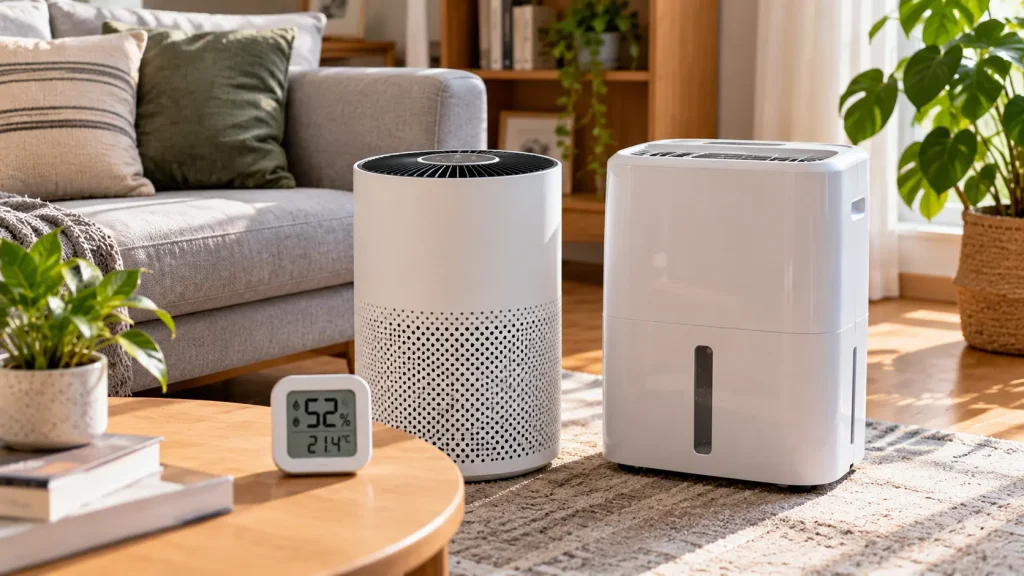
Your bedroom feels damp, or the living room seems dusty no matter how often you clean. You start looking for something to improve the air—and find air purifiers and dehumidifiers advertised with surprisingly similar promises.
They are not interchangeable.
An air purifier filters pollutants from the air. A dehumidifier removes excess moisture. Buying one to do the other’s job can leave you with the same problem and another appliance to maintain. US EPA
Before comparing prices, work out what you want to change: airborne particles, humidity, or a problem that needs fixing at its source.
The Main Difference: Particles vs. Moisture
A portable air purifier is designed to filter the air in a room or defined area. A dehumidifier is designed to reduce humidity in the space it serves. Neither automatically addresses every reason a room feels uncomfortable. US EPA
| What you want to address | More relevant starting point |
|---|---|
| Airborne dust or pollen | Particle filtration |
| Persistently high indoor humidity | Moisture control |
| Dampness combined with particle pollution | Assess both problems separately |
| A leaking wall or recurring mold patch | Find and fix the moisture source first |
These are starting points, not diagnoses. EPA guidance treats filtration as a supplement to controlling pollution sources, while its mold guidance emphasizes correcting water and moisture problems. US EPA
The most useful question is therefore not “Which machine is better?” It is “Which problem have I actually identified?”
Check Humidity Before Buying a Dehumidifier
A small humidity meter, often called a hygrometer, can help replace guesswork with a reading.
EPA recommends keeping indoor relative humidity below 60%, ideally between 30% and 50%. Treat that as general household guidance—not proof that every surface is dry or that a building has no leaks. Condensation and visible dampness still deserve attention. US EPA
For your own comparison, record readings in the affected room at different times. Note whether you have just showered, cooked or dried laundry nearby.
A single reading gives you a snapshot. Your notes can show whether the concern is persistent or tied to an activity.
Also check what is physically wet. A damp patch appearing after rain calls for a different investigation from a room that consistently feels humid without an obvious leak.
Do not let a reassuring number persuade you to ignore visible water damage.
What an Air Purifier Can—and Cannot—Remove
Particle filtration can reduce airborne contaminants, but it does not remove everything.
A HEPA filter is intended for particles. Gases and some odors require a different filter medium, such as activated carbon. EPA notes that meaningful gas filtration depends partly on having enough suitable material; a particle-filter claim alone does not establish odor-removal performance. US EPA
That matters when comparing a product advertised for “dust, smells and fresh air.”
Ask what each claim refers to. Is it describing particle removal, gas filtration or simply a fragrance?
Avoid devices that intentionally generate ozone for use in occupied rooms. EPA warns that ozone can irritate and damage the lungs, and that concentrations within public-health limits are generally ineffective at controlling indoor pollution. US EPA
Do not treat the smell produced by an appliance as evidence that the air has become cleaner.
A Musty Smell Is Not Just a Shopping Problem
A persistent musty odor warrants investigation rather than a stronger fragrance or a larger appliance.
EPA explains that air cleaners may capture some particles associated with mold, but they do not correct the moisture conditions allowing it to grow. US EPA
A dehumidifier can help manage airborne moisture. It cannot repair a leaking pipe or remove existing mold from damaged material. EPA’s advice is to address both the mold and the underlying water problem; suspected hidden mold may require an experienced professional. US EPA
Before buying, write down where the smell is strongest and when it appears. That is useful information for an inspection—and a better starting point than assuming every odor needs filtration.
Compare the Specifications That Match the Job
For an air purifier, look beyond the filter label
Clean Air Delivery Rate, or CADR, describes how quickly a unit delivers filtered air. ENERGY STAR recommends matching this performance to the room’s size, with higher ceilings potentially requiring greater capacity. ENERGY STAR
Check the performance at a fan speed you can tolerate. EPA notes that CADR is typically measured at the highest speed; a quieter setting filters less air. Also check replacement-filter prices and availability before committing to a model. US EPA
A useful question for a seller is:
What performance can I expect at the setting I will actually use?
For a dehumidifier, distinguish extraction from tank size
Daily moisture-removal capacity and water-tank capacity are different specifications. The required extraction capacity depends on room size and dampness; the tank determines how much water can collect before emptying.
Also check the operating-temperature range, drainage options and humidity controls. ENERGY STAR highlights these as practical buying considerations, particularly for cooler spaces. ENERGY STAR
An inconvenient drainage arrangement can become a daily annoyance. Decide where the collected water will go before deciding where the machine will stand.
Consider Running Costs, Not Just the Purchase Price
Rather than assuming one category is always cheaper to operate, compare the models and the way you expect to use them.
A simple electricity estimate is:
Average power in watts × hours used per day × days ÷ 1,000 = kilowatt-hours
For an illustrative appliance averaging 40W over 10 hours a day:
40 × 10 × 30 ÷ 1,000 = 12 kWh per month
At a hypothetical electricity rate of $0.20 per kWh, that would cost:
12 × $0.20 = $2.40 per month
This is a calculation example, not a typical consumption claim for either appliance.
Use your electricity rate and realistic operating data. A maximum input rating is not necessarily the average draw throughout the day.
Then add consumables and maintenance to your comparison. A lower purchase price is less persuasive if replacement filters are difficult to obtain or expensive.
Can You Use Both in the Same Room?
Using both can make sense when you have identified two separate needs. It should not be an automatic upgrade simply because two machines sound more thorough.
For example, in a hypothetical household, recurring high humidity and a separate concern about airborne particles would justify considering moisture control and filtration independently. That follows from the different functions of the appliances—not a promise that every home benefits from both. US EPA
Plan the layout, too. Follow each manual’s clearance requirements and keep air intakes and outlets unobstructed. Keep dehumidifier drainage away from electrical cords and connections. ENERGY STAR
Do not squeeze both appliances behind furniture simply to keep them out of sight.
Decide What Improvement You Will Look For
Before spending money, finish this sentence:
I want this appliance to address ______, and I will check whether it helps by ______.
For a humidity problem, that might mean comparing readings and condensation under similar conditions. For filtration, it means selecting equipment with suitable, documented performance rather than relying on whether the room “smells fresher.”
Start with the source where possible. EPA identifies reducing pollutants and ventilating with clean outdoor air as the main approaches, with filtration providing additional help. US EPA
You may need an appliance. You may first need a repair, a change in ventilation or better information about what is happening.
The right purchase is the one matched to a specific problem—not the one with the broadest promise of better air.