Yes, unplugging an appliance can save electricity—but only if it was drawing power while you weren’t using it. The savings depend on how much power it consumes, how long it stays plugged in and what you pay for electricity.
A device can look switched off while still using energy. Lawrence Berkeley National Laboratory describes this as standby power: electricity consumed when equipment is switched off or not performing its main function.
That does not mean every plug in your home is secretly adding a large amount to your bill.
The useful question is not, “What can I unplug?” It is:
“Which devices are using electricity for functions I don’t actually need?”
Why “Off” Does Not Always Mean No Power
Pressing the power button can leave parts of a device active.
A television may remain ready to respond to its remote. A microwave can keep its clock illuminated. Other equipment maintains a network connection or keeps controls ready for use. These are examples of functions that can require power even when the main task has stopped.
Some of that consumption is useful. Some is unnecessary.
It is also important to separate standby consumption from normal operation. A refrigerator maintaining its temperature is doing the job you bought it for. Its electricity use is not automatically waste just because nobody is opening the door. Energy Saving Trust specifically advises leaving refrigerators and freezers powered during normal use.
Start by identifying what a device is doing before deciding whether to disconnect it.
How Much Money Could You Actually Save?
You do not need a complicated calculator.
For a device with a reasonably steady standby draw, use:
Standby watts × unused hours per day × 365 ÷ 1,000 = annual kilowatt-hours
Then:
Annual kilowatt-hours × electricity price per kilowatt-hour = annual cost
Suppose an unused group of electronics draws 15 watts for 20 hours a day.
The calculation is:
15 × 20 × 365 ÷ 1,000 = 109.5 kWh per year
At an illustrative electricity price of $0.20 per kWh, that costs:
109.5 × $0.20 = $21.90 per year
Here is how different measured loads compare under the same assumptions:
| Power eliminated for 20 hours each day | Electricity saved per year | Annual saving at $0.20/kWh |
|---|---|---|
| 0.5W | 3.65 kWh | $0.73 |
| 5W | 36.5 kWh | $7.30 |
| 15W | 109.5 kWh | $21.90 |
| 30W | 219 kWh | $43.80 |
These are calculated examples, not measured results for particular appliances. The electricity price is hypothetical. The figures assume the stated load is eliminated throughout those unused hours.
The difference matters.
Spending time every evening disconnecting a single device that saves less than a dollar a year may not feel worthwhile. Switching off several unused devices with one accessible switch could be a much easier habit.
Use your own electricity rate and realistic hours. A device you disconnect for eight hours a night will not produce the same savings as one disconnected for twenty.
Measure Before You Blame the Appliance
A light, clock or remote control can suggest standby consumption, but appearance alone does not tell you the amount.
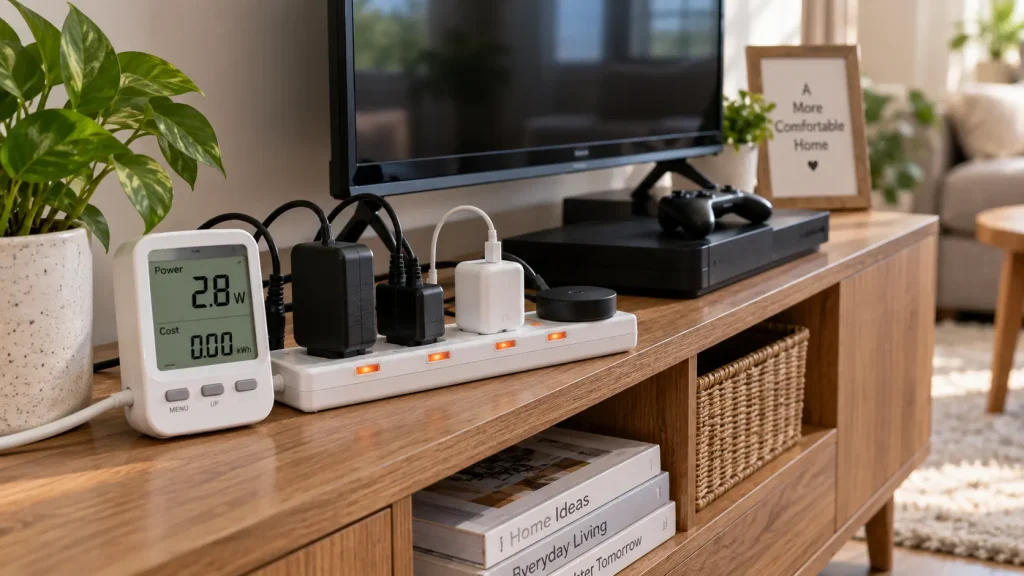
For accessible, plug-in equipment, a compatible electricity-use meter can help. It sits between the wall outlet and the appliance. Berkeley Lab recommends this approach and notes that low-cost meters can have proportionally larger errors when measuring loads below about one watt.
Follow the meter’s instructions and stay within its voltage, current and power ratings. Do not use an ordinary plug-in meter on hardwired equipment or improvise adapters for incompatible plugs.
Compare the device while operating and after shutting it down normally. If the reading changes over time, do not treat a momentary peak as its constant overnight consumption.
For the calculation above, use the measured unused-state draw—not a figure describing the appliance’s maximum operating power.
A television’s full-use consumption and its standby consumption answer different questions.
Start With Equipment You Rarely Use
The simplest place to look is not necessarily the newest phone charger. It may be the equipment you have almost forgotten about.
Berkeley Lab’s suggestions include unused televisions and associated audio equipment, rarely used office devices, empty chargers and seasonal equipment. It gives particular priority to older products that are seldom used.
Walk through a spare room or home office and ask:
- Is this device still used?
- Does anyone need it available remotely?
- Is it waiting for a task that no longer happens?
An unused audio system is a straightforward candidate. So is a charger left connected after the device it served has been replaced.
For seasonal equipment, check the manufacturer’s storage and shutdown instructions first. A product that will remain unused for months deserves a different decision from something used several times a day.
There is no need to reorganize the whole house. Start with one clearly unnecessary load and see whether the change causes any inconvenience.
Check Settings Before Pulling the Plug
Disconnecting power is not the only way to reduce unnecessary consumption.
Berkeley Lab notes that some loads are better addressed through settings—for example, enabling computer sleep or disabling an unneeded heating or cooling function on certain appliances.
Look in the manual or settings for power-management options that match how you use the device.
The right compromise might be a lower-power mode rather than complete disconnection. You may want an appliance available during the day but have no use for instant availability overnight.
After changing a setting, check that the features you rely on still work. Do not assume that a setting called “Eco” behaves identically across different products.
Keep the setting only if its trade-offs make sense for your household.
Which Devices Should Stay Connected?
Do not apply a blanket rule to every outlet.
Refrigerators and freezers need power to preserve their contents. Some recording equipment must remain connected to carry out scheduled recordings. Energy Saving Trust recommends checking appliance instructions rather than assuming everything can be switched off without consequences.
As a safety rule, also exclude equipment needed for medical care, alarms, essential monitoring or other protective functions from a casual unplugging experiment.
For connected equipment, ask what depends on it. Would switching it off interrupt a service you still need?
The purpose of this exercise is to remove unnecessary consumption, not necessary functions.
Shut equipment down through its normal controls before disconnecting it, and follow any model-specific instructions about keeping power available. Do not interrupt an update or maintenance process just to eliminate a small overnight load.
Can a Power Strip Make This Easier?
A switched power strip can make it convenient to disconnect a suitable group of electronics together. Berkeley Lab suggests this for clusters of computer or entertainment equipment.
That is useful only when all the connected devices can safely be turned off at the same time.
For example, do not put something you need continuously on the same switch as equipment you intend to disconnect every evening.
Check the strip’s rating against the equipment connected to it. Electrical Safety First warns against exceeding an extension lead’s maximum current rating or plugging one extension lead into another.
Do not use a convenient strip as an excuse to combine several high-power appliances. Follow each appliance’s connection requirements.
If a plug or socket has burn marks, makes unusual crackling sounds or becomes excessively hot, stop treating the situation as an energy-saving project and seek qualified help. Those are warning signs identified by Electrical Safety First.
Is It Worth Buying Something to Save Standby Electricity?
Do the arithmetic before buying an accessory purely for savings.
Suppose a proposed setup would eliminate the 5W load in the earlier example. Its calculated saving is $7.30 per year.
If an accessory costs $20, the simple payback period would be:
$20 ÷ $7.30 = about 2.7 years
That calculation excludes any electricity the accessory itself might use and assumes you follow the intended schedule every day.
Convenience may still justify the purchase. But the saving alone does not automatically make every energy-saving gadget a good deal.
For a small load, using an existing accessible switch may be more practical than adding another device.
Do Not Let Small Savings Distract You From Larger Ones
Standby consumption is worth checking, but it is only one part of household electricity use.
Energy Saving Trust identifies appliances that heat, cool or operate for long periods as important contributors. Its guidance includes using laundry equipment efficiently, avoiding unnecessary dryer use and choosing appropriate settings for household tasks.
This suggests a sensible order for your effort.
Remove obvious unused loads first. Then look at the equipment you operate regularly and whether it is being used efficiently.
There is little benefit in spending weeks hunting for fractions of a watt while overlooking a much larger, avoidable load.
Nor should you replace a functioning appliance solely because it has a small standby draw. Compare the purchase cost with the savings you can realistically expect.
A Practical Place to Begin
Choose one room and identify the equipment that stays connected between uses.
Separate it into three groups: things that must remain available, things you use frequently and things you rarely use at all. Check the manuals where the consequences of switching off are unclear.
Measure one uncertain load if a suitable meter is available. Calculate its cost, then choose a change you are likely to maintain.
You might discover that an unused entertainment setup is worth disconnecting. You might also discover that a particular device’s standby cost is too small to justify much attention.
Both are useful results.
Unplugging appliances can save electricity. The worthwhile savings come from identifying unnecessary loads—not from making every outlet in the house empty.